


Tuckpointing and repointing are often treated as the same masonry service, but technically they are different.
Repointing repairs deteriorated mortar joints by removing failed mortar and replacing it with compatible new mortar. Traditional tuckpointing is primarily a decorative technique used to create narrow, clean-looking joint lines. Because contractors and homeowners often use the word “tuckpointing” for mortar repair, the most important question is not only what the service is called, but exactly what work will be performed.
Understanding that distinction can help homeowners compare masonry estimates more accurately and choose a repair that matches the actual condition of their brickwork.
Tuckpointing vs. Repointing: Quick Comparison
| Feature | Repointing | Traditional Tuckpointing |
| Main purpose | Repair deteriorated mortar | Improve joint appearance |
| Failed mortar removed | Yes, where needed | Not necessarily the main purpose |
| New mortar installed | Yes | May be used as part of preparation |
| Decorative joint line | No special contrasting line required | Yes, traditionally |
| Best suited for | Mortar deterioration | Decorative or historic-style joint detailing |
| Primary result | Restored mortar joints | Refined visual appearance |
The confusion comes from modern trade usage. Many masonry contractors use “tuckpointing” as a general term for repairing mortar joints, even though the technical repair being described may actually be repointing.
That is why homeowners should compare the scope of work, not just the label.
What Is Repointing?
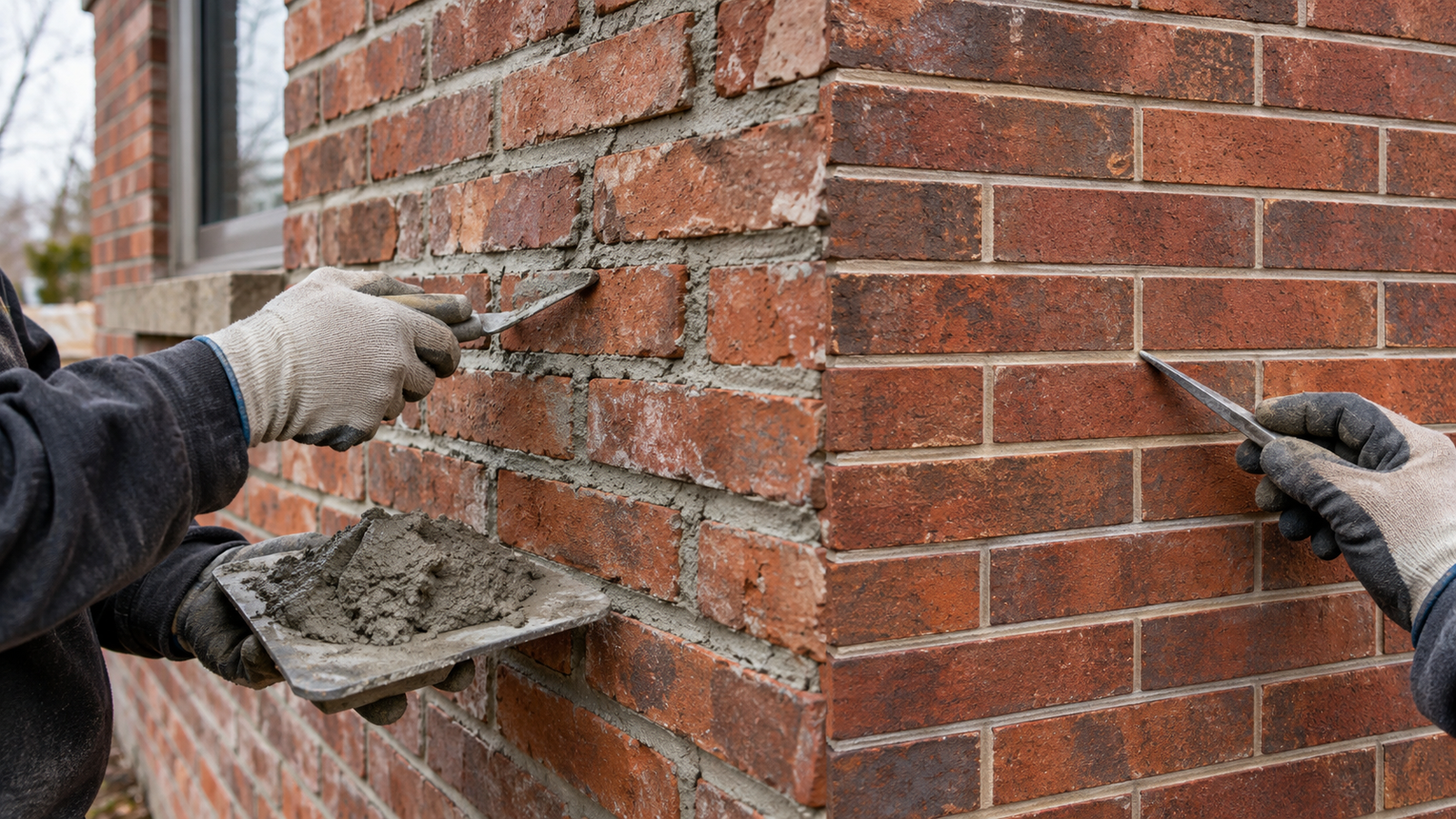
Repointing is the repair of deteriorated mortar joints in brick, stone, or other masonry.
The damaged portion of the mortar is removed, the joint is prepared, and new compatible mortar is installed. The goal is to restore the joint rather than simply cover its surface.
The U.S. National Park Service uses the term repointing for the process of removing deteriorated mortar from masonry joints and replacing it with new mortar.
For technical guidance, see the National Park Service Preservation Brief 2: Repointing Mortar Joints in Historic Masonry Buildings.
Repointing is therefore primarily a repair and maintenance process.
If mortar is cracking, eroding, missing, or no longer performing properly, repointing is usually the more technically accurate term for the work needed at the joints.
What Is Traditional Tuckpointing?
Traditional tuckpointing has a different purpose.
Historically, tuckpointing was used to create the appearance of very fine, precise mortar joints. A mortar background was finished to blend with the masonry, and a thin contrasting line was added to produce a crisp, uniform appearance.
The technique is therefore strongly associated with appearance and craftsmanship, rather than simply replacing deteriorated mortar.
Today, however, many homeowners searching for “tuckpointing” are actually looking for mortar-joint repair.
That modern usage is why the two terms frequently overlap in contractor websites, estimates, and homeowner conversations.
If you want a more detailed introduction to the service itself, see Townley Masonry’s guide to what tuckpointing is and when it is needed.
What Is the Main Difference Between Tuckpointing and Repointing?
The easiest way to understand the difference is to compare purpose, method, and finished result.
1. Purpose
Repointing:
The main purpose is to repair deteriorated mortar.
Traditional tuckpointing:
The main purpose is to create a refined decorative joint appearance.
That distinction matters because a homeowner with failing mortar has a different problem from someone whose masonry is structurally serviceable but needs a particular historic or decorative finish.
2. Method
Repointing begins with the condition of the existing joint. Unsound mortar is removed and replaced with compatible new mortar.
Traditional tuckpointing focuses more heavily on the visible joint finish. It may involve preparing or renewing mortar first, but its defining feature is the narrow contrasting line used to produce a precise appearance.
3. Finished Appearance
Repointing is intended to restore the mortar joint appropriately for the masonry.
The finished joint can still look clean and attractive, but creating a contrasting decorative line is not its defining purpose.
Traditional tuckpointing places greater emphasis on that visual detail.
Why Are Tuckpointing and Repointing Often Confused?
The biggest reason is everyday construction terminology.
Many contractors use “tuckpointing” as the familiar customer-facing term for removing and replacing deteriorated mortar. Homeowners also commonly search for phrases such as “brick tuckpointing” or “chimney tuckpointing” when their real concern is damaged mortar.
So a contractor may advertise tuckpointing, while the actual scope of work closely resembles technical repointing.
That does not automatically mean the contractor is offering the wrong service. It means the terminology alone does not tell you enough.
A homeowner should ask:
- Will deteriorated mortar be removed?
- How much of the joint will be prepared?
- What type of replacement mortar will be used?
- Will the new mortar be matched to the existing masonry?
- What joint profile will be created?
- Are damaged bricks included separately?
- Is the work primarily repair, decorative finishing, or both?
Those questions reveal much more than the service name.
Which One Does Your Brickwork Actually Need?
The condition of the masonry should determine the work.
If the mortar is physically failing, the priority is usually to repair the deteriorated joints. That means removing unsound mortar and replacing it with compatible material.
In technical terms, that is repointing.
If the existing masonry is suitable and the main objective is a particular decorative joint appearance, traditional tuckpointing may be relevant.
Some projects can involve both repair and appearance considerations. For example, deteriorated joints may first need repair before a more specific visual finish can be created.
The important principle is simple:
Repair should address the condition of the masonry first; terminology and appearance come second.
If your project involves deteriorated brickwork or mortar joints, Townley Masonry’s brick repair and mortar-joint services can help determine the appropriate repair scope.
When Is Repointing the More Appropriate Approach?
Repointing generally makes more sense when the main problem is deterioration within the mortar joints.
Examples include situations where the mortar is:
- Missing in portions of the wall
- Breaking a part
- Eroded beyond its intended joint profile
- Separating from surrounding masonry
- No longer providing a sound joint
The goal in these situations is not simply to make the joints look sharper.
The goal is to remove failed material and create a compatible repair.
However, mortar deterioration should still be evaluated in context. If a wall has significant movement, badly damaged brick, support problems, or another underlying condition, joint repair alone may not address the full issue.
When Is Traditional Tuckpointing Appropriate?
Traditional tuckpointing is more relevant when the appearance of the masonry joints is a major part of the project.
It can be particularly useful when a building or masonry feature calls for a refined, narrow-joint appearance or historically appropriate decorative detailing.
But decorative work should not be used to hide deteriorated joints.
If existing mortar is failing, the damaged material needs to be properly addressed before appearance becomes the main concern.
This is one of the most important distinctions between the two methods.
Repointing begins with repair. Traditional tuckpointing is distinguished by its finish.
Does the Difference Matter for Chimneys?
Yes, especially when comparing estimates.
A homeowner may request “chimney tuckpointing” because that is the common phrase they know. But if the chimney has deteriorated mortar, the actual masonry work may involve removing failed joints and installing replacement mortar.
That is technically repointing.
If the chimney also has cracked or spalled bricks, displacement, crown damage, or other masonry issues, joint work may be only one part of the repair.
Townley Masonry’s chimney masonry repair services can help evaluate whether the work involves mortar joints, brick replacement, or a broader chimney repair.
The important takeaway is not whether someone uses the word “tuckpointing” or “repointing.” It is whether the proposed scope accurately addresses the chimney’s condition.
Why Mortar Compatibility Matters in Both Methods
Regardless of terminology, replacement mortar needs to be appropriate for the existing masonry.
Mortar should not be selected simply because it is the strongest available mix.
Older brick, modern brick, stone, and other masonry materials can have different physical characteristics. A replacement mortar that behaves very differently from the original materials can create unnecessary stress or moisture-related problems.
The National Park Service specifically emphasizes compatibility when repointing historic masonry and discusses factors such as hardness, permeability, appearance, and composition.
See the National Park Service’s technical guidance on repointing historic masonry.
For homeowners, the practical question to ask a contractor is:
“How will you select the replacement mortar for my existing masonry?”
That question is more useful than simply asking whether the job is called tuckpointing or repointing.
Tuckpointing vs. Repointing in Duluth, Minnesota
The terminology can be especially important in a climate where masonry receives significant seasonal exposure.
In Duluth and Northern Minnesota, masonry can experience rain, snow, moisture, freezing temperatures, and repeated seasonal changes.
If those conditions have contributed to mortar deterioration, the priority should be identifying what material has actually failed and what repair is appropriate.
A decorative treatment should not substitute for necessary mortar-joint repair.
Likewise, not every masonry project requires extensive replacement simply because the building is older.
A professional assessment can help distinguish between:
- Mortar that needs repair
- Brick that needs separate attention
- Sound masonry that mainly needs maintenance
- Decorative joint work
- A condition requiring a broader repair
Townley Masonry serves Duluth and surrounding communities with masonry repair services for brick, chimneys, and related masonry features.
Questions to Ask Before Hiring a Mason
Because tuckpointing and repointing terminology varies, ask for a clear written scope.
Useful questions include:
What mortar will actually be removed?
Ask whether only loose surface material is being addressed or whether deteriorated mortar will be properly removed from the joint.
What replacement mortar will be used?
The contractor should consider the existing masonry rather than choosing mortar based only on strength or color.
Is the purpose repair or appearance?
This question quickly clarifies whether the project is primarily repointing, traditional decorative tuckpointing, or a combination.
Will damaged bricks be handled separately?
Mortar-joint work does not automatically repair cracked, spalled, or displaced bricks.
What joint finish will be used?
The final profile affects both appearance and how the repair relates visually to the surrounding masonry.
Are there other problems that should be addressed first?
Moisture sources, movement, drainage, flashing, or other conditions may need attention before or alongside mortar work.
A good proposal should explain the work clearly enough that you understand what is being repaired, what materials are being used, and what the finished masonry should look like.
Frequently Asked Questions About Tuckpointing vs. Repointing
Are tuckpointing and repointing the same thing?
Not technically. Repointing means removing deteriorated mortar and replacing it with new compatible mortar. Traditional tuckpointing is a decorative technique that creates fine, contrasting joint lines. However, the terms are often used interchangeably in modern contractor and homeowner language.
Which is used to repair deteriorated mortar?
Repointing is the technically accurate term for repairing deteriorated mortar joints. A contractor may still describe the service as tuckpointing, so homeowners should confirm exactly what mortar will be removed and replaced.
Is tuckpointing decorative?
Traditional tuckpointing is primarily associated with decorative joint detailing. It creates a fine, precise appearance using contrasting joint lines. Modern contractors may also use “tuckpointing” more broadly to describe mortar-joint repair.
Which is better: tuckpointing or repointing?
Neither is universally “better.” They serve different purposes. Repointing is appropriate when deteriorated mortar needs repair. Traditional tuckpointing is more focused on a particular decorative joint appearance. The masonry’s actual condition should determine the method.
Why do contractors use the terms interchangeably?
“Tuckpointing” has become a common customer-facing term for mortar-joint repair in the United States. Because usage varies, comparing the written scope of work is more reliable than relying only on the service name.
Can a chimney need repointing?
Yes. If a chimney’s mortar joints are deteriorated but much of the surrounding masonry remains suitable, joint repair may involve repointing. Damaged bricks or other chimney components may require separate work.
Does repointing repair damaged bricks?
No. Repointing repairs mortar joints. Cracked, spalled, loose, or broken bricks may require separate replacement, resetting, or other masonry repair.
Choosing the Right Mortar-Joint Service
The key difference in tuckpointing vs. repointing comes down to purpose.
Repointing repairs deteriorated mortar. Traditional tuckpointing is distinguished by decorative joint detailing.
Because the terms are commonly mixed in everyday contracting language, homeowners should focus on the proposed work: what material will be removed, what mortar will replace it, whether damaged bricks need separate repair, and what finished joint profile will be created.
If you have deteriorated brick or chimney mortar in Duluth or a surrounding community, Townley Masonry can evaluate the masonry and explain which repair approach fits the existing condition.
